

ॐ श्री वैष्णवी नमः। पाद्योः पाद्यं समर्पयामि। हिरण्यगर्भ-गर्भस्थं हेम बीजं विभावसोः।
अनन्तं पुण्यफ़ल दमतः शान्ति प्रयच्छ मे।।
Located on the Trikuta Mountains in Jammu and Kashmir, the holy shrine of Mata Vaishno Devi is one of the most revered and sacred temples in India. This temple holds immense significance among Hindus and is considered a must-visit for anyone seeking spiritual solace and enlightenment. Every year, millions of devotees throng to this temple to seek blessings from the goddess. The journey to this holy shrine is not an easy one, but it is believed that the challenges one faces on the way only strengthen their faith and devotion towards the goddess.
The trek to Mata Vaishno Devi temple is a test of both physical and mental strength. The trek starts from Katra, a small town near Jammu, and extends for 13 kilometers. The path is steep and rocky, with many devotees choosing to walk barefoot as a mark of their devotion. Some even crawl the entire distance with the belief that it will please the goddess and fulfill their wishes.
The journey to Mata Vaishno Devi temple is not just a physical one; it is a spiritual experience that teaches devotees about perseverance, determination, and unwavering faith. Along the way, one can feel a sense of camaraderie with fellow pilgrims from all walks of life. This temple is a symbol of unity and inclusivity, where people from all backgrounds come together to seek blessings from the divine mother. The legend goes that Mata Vaishno Devi manifested herself in the form of a young girl to bless her devotees and fulfill their wishes. It is believed that she bestows her devotees with strength, sight, wealth, and fertility, making her a beloved deity among Hindus. People from all over the country, and even from abroad, visit this temple to seek her blessings and fulfill their desires.
Apart from the challenging trek, there are other modes of transportation available for those who are unable to make the journey on foot. Helicopter services are available from Katra to Sanjichhat, which is the last stop before the temple. From here, one has to walk for about 2 kilometers to reach the temple. Moreover, Katra is also a hub for local handicrafts and delicious cuisine. One can find a variety of souvenirs and religious items in the many shops lining the streets of Katra. The local delicacies like rajma chawal (red kidney beans with rice) and khatta meetha aloo (sweet and sour potatoes) are a must-try for food enthusiasts. In this blog, we will take you through the various points to reach Mata Vaishno Devi starting from Kol Kandoli.
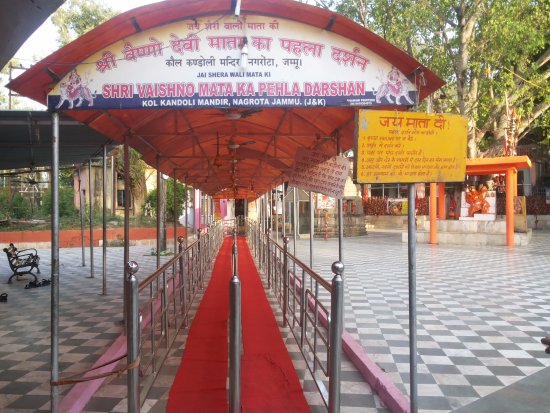
Kol Kandoli Temple, situated in the city of Nagrota in the Jammu & Kashmir state, is a holy place of worship for followers of the Hindu faith. Located 14 km away from Jammu, it is the first darshan or sighting of Mata Vaishno Devi, and is considered to be the gateway to the Vaishno Devi yatra. The trek to Mata Vaishno Devi shrine starts from here and it is divided into three main points – Banganga, Adhkuwari, and Sanjichhat. Dedicated to Mata Vaishno Devi, this temple is home to a pindi, representing the goddess. The name “Kol Kandoli” is derived from two words, “Kaul” meaning bowl and “Kandoli” meaning marbles. Legend has it that all devotees who are embarking on the journey to seek blessings of Mata Vaishno Devi must first visit this temple and offer their prayers. It is believed that the goddess herself resides in this holy place, blessing all her devotees with love, strength, and protection on their journey ahead. The Kol Kandoli Temple holds great significance for all those who undertake the pilgrimage to Vaishno Devi, making it an integral part of the spiritual journey.
According to mythology, Mata Vaishno appeared here at the age of 5 years in the form of a little girl and did penance here for 12 years. Mata played here with small girls and used to swing with local girls on nearby trees. Once when the girls felt thirst, Maiya gave them a bowl (Kol). When The Goddess shook the bowl on the ground, water started to coming out from the earth and then all the deities drank that water. The devotees then made a well there and named it after the Goddess.. After the penance, she settled here in the form of a pindi. In this temple, the Goddess Herself appears before the devotees in the form of a natural pindi and fulfils the wishes of Her devotees. The Goddess had herself played marbles and swing along with local girls here. During the 12 years penance, the Goddess performed many Havans for the world peace. Mahamaya had presented the silver bowls here four times. Mahamaya offered 36 types of food prepared in the silver bowls to 330 million deities.
In the Mahabharata era when Pandavas were under Agyat Vaas, they got to know about the Goddess in Nagraj village. Then they all visited the place and prayed before the Goddess for the ending of their agyaat vaas and also for retrieval of their kingdom. Then the Goddess appeared before them and asked them to build a temple for Her. They all built a temple there in one night which spanned for 6 months.
Charan Paduka
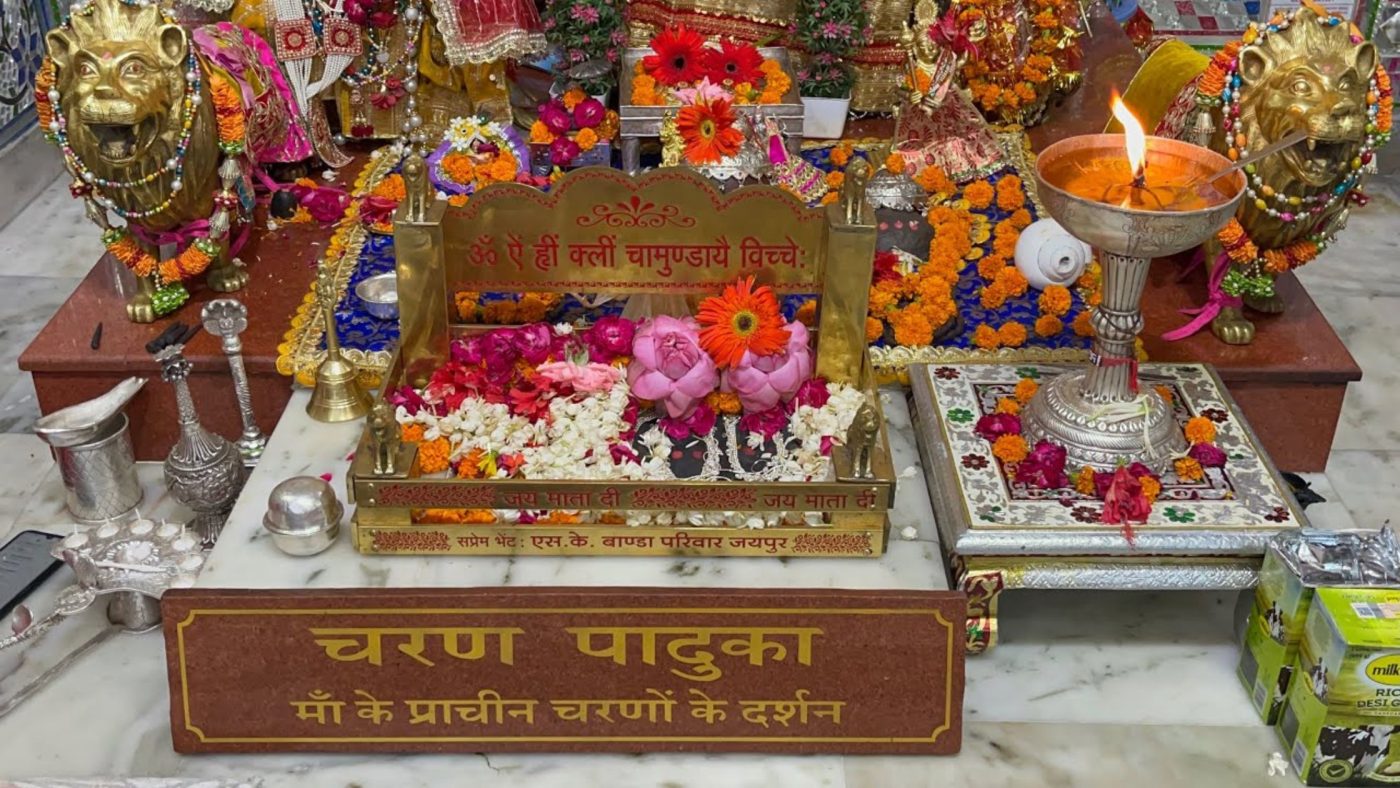
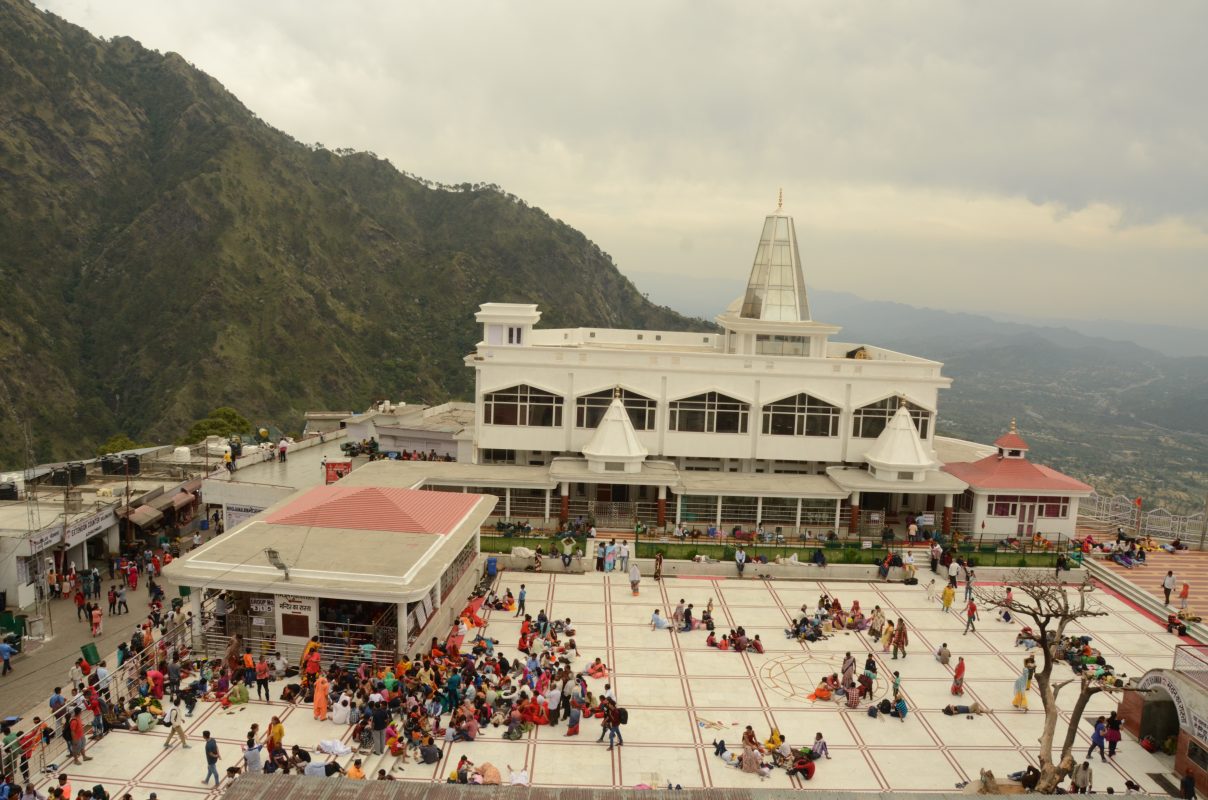
Charan Paduka, which translates to “footprints of the goddess”, is considered to be the starting point of the journey to Maa Vaishno Devi’s abode. It is a small rock that bears imprints believed to be that of Maa Vaishno Devi herself. These footprints are said to have been made when she first arrived at the Trikuta Mountains. This white temple is believed to be the place where Mata Vaishno Devi/Vaishnavi stopped over to check if she was still being chased by Bhairon Nath, the disciple of Mahayogi Guru Goraksh Nathji. In Charan Paduka Temple, the feet impression of Mata Vaishno Devi can be seen on a rock slab. The holy temple in Katra is situated at a height of 1030 m and is at a short distance away from Banganga River and Bridge.
ArdhKuwari
Ardhkuwari a separate cave to which an interesting legend is attached. This separate cave is said to be the place where Vaishno Devi hid from Bhairo Nath for 9 months. It is said, the Goddess positioned herself in the same way as an unborn child is placed in his/her mother’s womb. This cave is also known as Garbhjun as the shape of the cave resembles a mother’s womb.
According to believers, those who enter Garbhjun cave acquire freedom from entering the womb again. If incase one is born again/or is conceived by the mother then one is free from all the problems during childbirth. One has to crawl on the knees to reach the other side of the Ardhkuwari cave. Located halfway to Vaishno Devi Temple, Ardh Kuwari acts as a stopover for the pilgrims on their journey up to the Bhavan.
Bhawan – The main shrine of Maa Vaishno Devi

It is believed that a devotee can visit the shrine only if the Mother Goddess wishes so. Hence, there is a saying – “Chalo bulava aaya hai, Mata ne bulaya hai“.
The darshans are of three individual Pindies that look like natural rock formations. The black one is the Pindi of Goddess Mahakali which represents universal power, time, life, death, and both rebirth and liberation, Goddess Mahalakshmi – the goddess of wealth, fortune, power, beauty, fertility and prosperity and Maha Saraswati – who represents the purity of life and is
believed to be the supreme energy of creation that represents Sattva Guna. Sattva meaning wisdom and knowledge. Vaishno Devi is believed to be the bestower of strength to the weak, sight to the blind, wealth to the poor and bless childless couples with children. Every year, millions of devotees visit Mata Vaishno Devi, where they seek the blessings of the Mother Goddess, who is believed to grant the wishes of her devotees. That is why another saying goes – “Mann ki Muraden Puri Karne Wali Maa“
Bhairavnath Temple
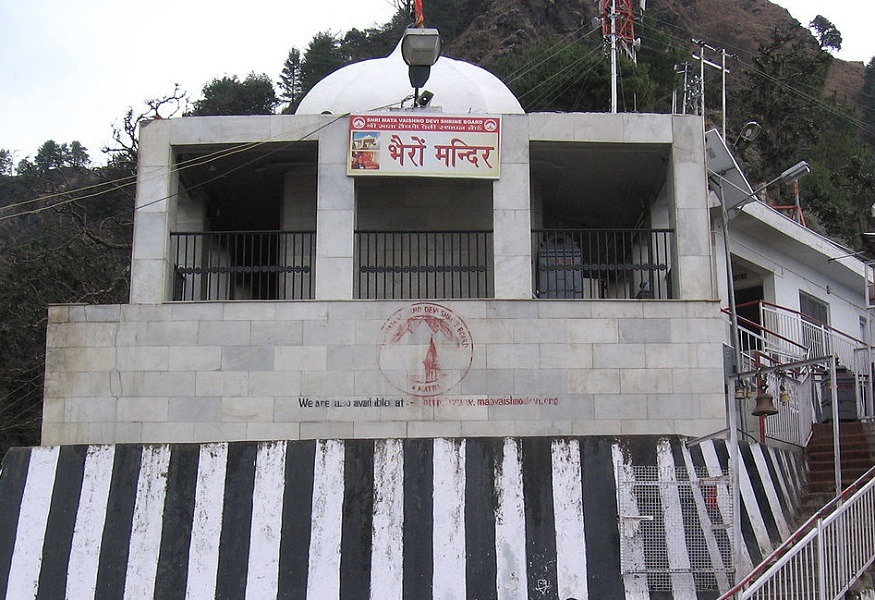
It is said that Mata Vaisho Devi Darshan is incomplete without having visited Bhairavnath Mandir. Bhairav or Bhairavnath is a famous tantrik of Hindu Deity. Bhairavnath was a disciple of Gorakhnath, whose guru was the Matsyendranath. He was considered to have control over all tantrik siddhis and had grown arrogant of his power. He went after Vaishno Devi, considering her to be a little girl. It was only when mata Vaishno Devi took the form of Kali to behead him he realized her true form and asked for forgiveness. Kaal Bhairav (Baba Bhairavnath) was killed by Maa Vaishnodevi, and during his last breath, he repented his sins. The goddess forgave him and said that no pilgrimage to Vaishno Devi will be complete without visiting the Bhairav Temple.
The cave temple of Bhairavnath is dedicated to Baba Bhairavnath and is constructed at the site where he is believed to have breathed his last. A steep 3km journey from the Bhawan leads you to Bhairavnath temple. Ponies are available for the up-down journey in case you can not climb the steep stairs. There is also a ropeway from Vaishno Devi Temple to Bhairavnath Temple at a cost of INR 100 per person.
Shri Mata Vaishno Devi Ji, also known as Vaishnavi or Trikuta, is a revered deity in the Hindu religion. She is believed to be an incarnation of the three Supreme Energies – MAHA KALI, MAHA LAKSHMI, MAHA SARASWATI. The Holy Cave of Vaishno Devi is considered to be her abode, where devotees can seek her blessings and enlightenment. The main Darshans in the Holy Cave are of the three Pindies or rock formations that represent these three energies. Each Pindi is associated with a specific divine power and has its own significance. However, the Darshan of Bhairon, a fierce form of Lord Shiva, is also an important aspect of the pilgrimage for devotees. It is believed that Vaishno Devi Ji had to defeat Bhairon before attaining her true form as a goddess and achieving liberation. Thus, devotees make it a point to visit Bhairon’s temple and seek blessings from him as well. This pilgrimage to the Holy Cave of Vaishno Devi is not only about seeking physical blessings but also about spiritual growth and enlightenment through the Darshans of these divine energies.
HIGHLIGHTS
1) The nearest railway station to Katra is Jammu Tawi, which is well-connected with major cities in India. From Jammu Tawi, you can hire a taxi or take a bus to reach Kol Kandoli.
2) Katra to Mata Vaihno Devi Bhawan by means of Palki
Approx. charges per person Rs.4,000/-
3) Katra to Mata Vaishno Devi Bhawan by way of Horse
Approx. charges per person varies from Rs.1,000/- to 1,500/-
4) Vaishno Devi Bhawan to Bhairav Nath Temple by means of Ropeway
Approx. charges per person : Rs. 100/-
NOTE
Though the rates are available on various sign boards and at the Assistance Centers at Katra, Banganga and other places, it is advisable to check the currently prevailing rates from the Assistance Counters or the sign boards.
CONCLUSION
The Mata Vaishno Devi and Bhairav Yatra is a sacred pilgrimage for Hindus that holds great significance and importance in their religious beliefs. The journey to the holy shrine of Mata Vaishno Devi, along with the visit to the temple of Bhairav Nath, is believed to bring spiritual fulfillment and blessings to devotees. The devotion and faith shown by millions of pilgrims every year is a testament to the divine power and deep-rooted faith in these deities. The Yatra serves as a reminder of the strong connection between spirituality and humanity, and how it continues to bring people together in their pursuit of spiritual enlightenment.
